Organyze
Vision Statement
Throughout the day, nearly everyone is faced with the challenge of managing multiple responsibilities across a variety of contexts, including their job, education, and personal/social life. Whether one is working to maintain their daily routine or change it to accommodate a different lifestyle, habit formation remains the backbone of a person’s daily life.

Research
Research has shown that habits are most effectively maintained when performed repeatedly in the same context, and reinforced using a consistent system of cues and rewards. Due to the COVID-19 pandemic, the majority of individuals’ lives have been constrained to a single context: their home environment. This has made it doubly challenging to maintain a consistently healthy and productive lifestyle. Our team set out to create a robust, intuitive way for individuals to plan out their day and hold themselves accountable for completing the tasks required of them.
Context
Goal: Enable users to create, manage and fulfill their daily routines.
-
Timeframe: March - June 2021 (3 months)
-
Organization: University of Washington - HCDE 318: User-Centered Design
-
Team Members: Anahita Gharai, Tejus Krishnan, Rajbir Singh
-
Tools Used: Figma
Interviews
We interviewed three individuals of different ages and occupations, all of whom led busy lives with multiple daily responsibilities to meet. We wanted our product to answer to a range of productivity levels, from high-performing individuals to those struggling to fulfill their daily tasks. We emerged with the following findings:
Goals/Desires:
Enjoy life outside technology
Spend more time with family and friends
Have more structure to daily life
Pains:
Prioritizing important tasks
Integrating desired new habits into an existing routine
Attitudes about technology:
More varied; some were regular smartphone users and open to using smart home systems, others were going on a social media cleanse and working to avoid overreliance on technology
Personas
After our three interviews, we created two personas representing a composite of the interview responses we received. We distinguished the two personas by providing each with contrasting characteristics, to reflect the variation of our responses (particularly when it came to individuals’ productivity levels and attitudes regarding technology).


User Journey Map
For our user journey map, we wanted to see how our Lillian persona would navigate a first date situation, specifically, how her thoughts and moods changed as different actions took place. Lillian, for example, is not a very tech-savvy person and oftentimes, gets frustrated when people are too invested in technology.

Design Process
Based on our interviews, personas, and user journey maps, we came up with a list of design requirements and goals for our solution.
Some of our requirements include:
-
Help users prioritize their most important tasks
-
Display clearly the routines and tasks an individual has
-
Have a method of keeping track of new habits
-
A method to hold oneself accountable
Some design goals include:
-
Helps users create/reinforce a daily structure to help them become more productive during the day
-
Be accessible to all people, including those with disabilities
Ideation + Brainstorming
Based on our design requirements, we spent multiple team meetings ideating solutions and categorizing them by our user needs. We initially decided on a three-pronged approach that would combine software and hardware to enable individuals to create and manage their daily routines. It consisted of:
A mobile app
The use of smart home systems (such as Amazon Alexa)
Specialized wall projectors to display the contents of one’s routine around different parts of their household
The broader goal was to allow users to populate their homes with cures to reinforce their desired habits.
Storyboards
Using our design requirements and the solutions proposed during ideation, we created a series of storyboards depicting our multifaceted product in action, incorporating both the mobile app and the physical hardware into our scenario pathways. Our goal was to clearly communicate the ease and convenience our product would introduce to our users’ daily lives.
.png)
Project Scoping
As we approached the prototyping stage of the design, we realized that our combined digital/physical solution would be too broad for the scope of our project, and that we didn’t have a feasible way to represent the hardware component of our solution as a deliverable.
Additionally, we reasoned that the product’s use of smart home systems would violate the needs and privacy concerns of individuals who preferred not to over-rely on technology, as well as bias our product towards those affluent enough to afford a full-fledged smart home system in their households.
Therefore, we narrowed the scope of our project to a mobile app alone, which we felt was:
More feasible to implement within our timeframe
More intuitive and easily accessible to users
More respectful of our users’ needs and concerns
Product Features
Now that we were solely focusing on a mobile app experience, we had the time and freedom to dive deeper into creating features that would make the product stand out from conventional calendar/task-management apps.
Our most important addition was a social component to the app: allowing users to share the routines they create, either with their friends or with the public on a kind of “marketplace.” Given the popular demand for the morning routines of high-performing individuals, we felt that turning routines into a shareable entity on an app (like an Instagram post) would turn the often abstract world of self-help/productivity advice into a thriving, easily accessible ecosystem.
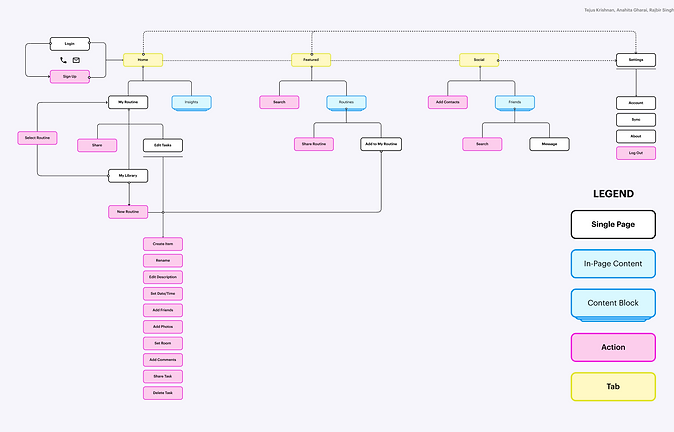
Through a second round of ideation, we divided our app into three primary workflows:
Routines - The primary function of the app. Includes creating, editing, and sharing tasks.
Social - For viewing and messaging your friends on the app, as well as viewing their routines
Featured - A public space for all users on the app to share and curate their routines.
Information Architecture
Our next step was to lay out what we wanted to include in our app. We did this by creating an information architecture diagram in Figma, which gave us a roadmap of the pages and functions to include in our low-fidelity prototype.
Wireframes + Low-Fidelity Prototype
Using our information architecture as a guideline, we created a series of wireframes which we converted into a low-fidelity prototype based on the annotations we provided to each screen.


Evaluation
In our user feedback, we tested our low-fidelity prototype on high school students. This evaluation session gave us the opportunity to observe pain points and workflow inconsistencies, as well as receive direct user feedback on our design.
Based on the feedback we received in our evaluation, we made the following changes to the app:
Switching the ‘Social’ and ‘Featured’ tabs to highlight the social component of the app better and make the app less social-media like
Auto-generating messages to hold friends accountable, such as “Don’t forget to meditate tomorrow when you wake up” given that the user can see their friends’ routine
Showing users when their friends are online to make messaging more efficient
Final Design
Final Design
Below is our final design of Organyze. These shots are to showcase the user adding routines to their calendar, editing their routines, viewing the featured pages and editing their own profile.
 |  |
|---|---|
 |  |
 |  |
Reflection
Points of Growth
Organyze gave us the opportunity to answer a universal human need - creating healthy and productive habits - during a time when daily life has been upended to an unprecedented degree. In the process, we each gained experience implementing all stages of the human-centered design cycle, which reinforced our skills in our individual areas of expertise while sharpening our abilities outside our respective comfort zones. In particular, we gained a firmer knowledge of design tools such as Figma, and learned how to adapt our deliverable to user feedback.
Challenges
As expected, the biggest challenge we faced throughout the project was staying coordinated as a team while working remotely. It was also surprisingly difficult anticipating which stages of the project would demand the most time and effort relative to the others. If we had control over the timeline of the project, we would definitely allocate more space towards refining the high-fidelity prototype.
For Next Time
If presented with the chance to do things differently, we would certainly devote more time to engineering the finer interaction details of the high-fidelity prototype, particularly when it comes to the routine editor workflow. We could not dive as deeply into these interaction mechanics due to time constraints; therefore, we would consolidate some of the early deliverables (particularly the personas, storyboards and user journey maps) to make more time for refining the prototype. As a team, we would also delegate tasks more strictly in order to get a clearer sense of the scope and time commitment of each deliverable. Nonetheless, we are proud of how our product turned out, and believe we laid the groundwork for genuinely improving the lives of others, while receiving a great deal of educational benefit ourselves.
Thank you for reading!